Showing posts with label tenses. Show all posts
Saturday, February 12, 2011

Future Progressive Tense

SpongeBob will be catching jellyfish at the same time tomorrow

(+) s + will/shall + be + v-ing + O + adverb of time
(-) s + will/shall + not + be + v-ing + O + adverb of time
(?) will/shall + s + be + v-ing + O + adverb of time?

Example:
(+) I will be riding a bicycle in Sunday morning.
(-) She will not be watching television at 8 o'clock tomorrow morning.
(?) Will she be waiting for me when I arrive at the airport?

Selengkapnya/Read more>>
Friday, September 17, 2010

Simple Future Tense

Mrs. Puff: I will free next week. :(
(+) S + will/shall/be going to + v-1 + O + adverb of time
(-) S + will/shall/be going to + not + O + adverb of time
(?) Will/shall/be going to + S + v-1 + O + adverb of time

Example:
She will help me next week.
I will not be here tomorrow
Shall we go to school?

Usage

To expresses future time. When the speaker is making a prediction, either will or be going to is possible.
Example:
I will go to Kandahar.
It is going to be rainy tomorrow.

To expresses a prior plan. When the speaker is expressing a prior plan (because he/she has made a plan or decision to do it) only be going to is used.
Example:
Why did you packing? I’m going to my hometown tomorrow.
I’m going to clean this house, because my parent will come.

To express willingness use will.
Example:
She’s coming. I will take her bag.
A: I don’t understand this.
B: I will help you.

Selengkapnya/Read more>>
Friday, September 3, 2010

Past Perfect Progressive

Plankton finally got the recipe. He had been trying to steal that for two years.
(+) S + had + been + v-ing + O + adverb of time
(-) S + had + not + been + v-ing + O + adverb of time
(?) had + S + been + v-ing + O + adverb of time.

Usage
To emphasize the duration of an activity that was in progress before another activity or time in the past.
Example:
The police had been looking for the criminal for two years before they caught him.
I had been studying Arabian language for two years last month.

Frequently used adverb
For …, by yesterday, since …, by last ….

Selengkapnya/Read more>>
Thursday, September 2, 2010

Past Perfect

Sasori to Deidara: 'He had already changed when you came.'

(+) S + had + v-3 + O
(-) S + had + not + v-3 + O
(?) Had + S + v-3 + O?

Usage
Express an activity that was complete before another activity or time in the past.
Example:
We had already arrived when the game began.
Ron had left before Mary got to library.

Frequently used adverb
After …: setelah
… before: sebelum
…when: …. Ketika

Selengkapnya/Read more>>
Saturday, August 28, 2010

Past Progressive

I was walking down the street when it began to rain.
(+) S + was/were + v-ing + O + adverb of time
(-) S + was/were + not + v-ing + O + adverb of time
(?) was/were + S + v-ing + O + adverb of time?

Usage

Indicate an activity or situation was in progress at particular time in the past.
Example:
At 08.00 pm yesterday we were playing video game.

Both action that occurred in the same time, but one action began earlier and was in progress when the other action occurred.
Example:
I was watching TV when she arrived. (The past progressive form ‘watching TV’ happen first and for the past form is second).
While I was studying last night, she called me.
 
Frequently used adverb
When…, while.., at… o’clock yesterday and other in the past.

Selengkapnya/Read more>>
Friday, August 27, 2010

Simple Past Tense

"We spent our time in the beach yesterday."
(+) S + v-2 + O + adverb of time
(-) S + did + not + v-1 + O + adverb of time
(?) Did + S + v-1 + O + adverb of time
Example:
I bought a newspaper yesterday
She didn’t come here last night
Did you come here last night?

Usage
Indicates an activity or situation began and ended at particular time in the past.
Example:
She went with me last night.
John didn’t bring a book last week.
Did you visit me two days ago?

If a sentence contains when, and has simple past in both clauses, the action in the when clause happens first.
Example:
(1st) When I heard strange voice, (2st) I got up to investigate.
She arrived when I watched TV last night. (watched TV happen first)

Selengkapnya/Read more>>
Wednesday, August 25, 2010

Present Perfect Progressive

Law: "I have been learning kung fu for 7 years."

(+) S + aux (have/has) + been + v-ing + O + adverb of time
(-) S + aux (have/has) not + been + v-ing + O + adverb of time
(?) Aux (have/has) + S + been + v-ing + O + adverb of time

Example:
I have been studying here for a year
She has not been living here for 5 years
Has John been working here for 3 months?

Usage

To indicate the duration of an activity that began in the past and continues to the present.
Example:
I have been waiting here since 8 o’clock
You have been studying for 2 ours

Expresses a general activity in progress recently, lately.
Example:
I have been thinking about buying a new car
The students have been sitting here

Adverb frequently used.
For= selama
Since= sejak
How long = berapa lama ?

Selengkapnya/Read more>>
Sunday, August 22, 2010

Present Perfect Tense

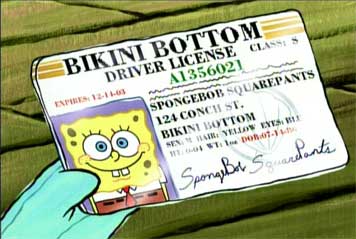
Sponge bob: "I have already finished my driving test."
(+) S + have/has + v-3 + O
(-) S + have/has + not + v-3 + O
(?) Have/has + S + v-3 + O
Example:
(+) I have finished my homework.
(-) She has not finished her homework.
(?) Have you finished your homework?

Usage
Expresses the idea that something happened (or never happened) before now, at an unspecified time in the past. The exact time is not important.
Example:
Have you ever visited Indonesia?
I have already beaten this game.

Expresses the repetition of an activity before now. The exact time is not important.
Example:
He has gone to Yemen twice.
I have met many people since I came here in August.

Expresses the situation began in the past and continues to the present.
Example:
I have had breakfast.
I have liked masked rider movies ever since I was child.

Selengkapnya/Read more>>
Saturday, August 21, 2010

Present Progressive


(+) S + to be (is,am,are) + v-ing + O + adverb of time
(-) S + to be + not + v-ing + O + adverb of time
(?) To be + S + v-ing + O + adverb of time
Example:
(+) Putri is sleeping right now.
(-) I am not reading right now
(?) Is she writing a letter?

Usage
Expresses an activity that is in progress at the moment of speaking.
Example:
She is reading a book.
The students are sitting at their desk right now.
I am dreaming about you.

Something generally in progress this week, this month, this year.
Example:
I am taking four courses this semester.
She is taking a rest this week.

Selengkapnya/Read more>>
Thursday, August 19, 2010

Simple Present Tense

Pola kalimat

(+) S + v1 (s/es) + O + ket. waktu
(-) S + do/does + not + v1 + O + ket. Waktu
(?) Do/does + S + v1 + O + ket. Waktu ?
Example:
(+) You read a newspaper everyday
(-) You don’t read a newspaper everyday
(?) Do you read a newspaper every morning?

Penggunaan

1. Untuk menyatakan suatu kebiasaan.
Example:
I get up at five every morning
She goes to college everyday

2. Untuk menyatakan kebenaran umum.
Example:
The world is round.
A year has twelve months.

Keterangan waktu
Adverd of frequency (kebiasaan)
Always, usually, generally, ever (?), never, sometimes, occasionally, seldom.
Adverb of quantity (keseringan)
Once a day, .. a week, .. a month, twice.., three times.., every..

Selengkapnya/Read more>>